Final: What Does It Mean to Save Yourself
Up to this point, you've always ended up in the same place:
Responsibility.
We said, "Don't hide in the past."
We said, "Don't fixate on the trauma."
We said stop using anger as a tool.
We said step out of seeking approval.
We said step out of the race.
We said step into contribution.
We said, "Come to the present."
All of this was for one thing:
To save yourself.
But “saving yourself” is a phrase that's very prone to misunderstanding.
Some people think it means, “I've pulled myself together; I don't need anyone anymore.”
Some people think it means, “I love myself; everything is fine.”
Some people think it means, “I've erased my past; I'm free.”
No.
Saving yourself is not escaping from the world.
Saving yourself is not about eliminating pain.
Saving yourself is not about always feeling good.
Saving yourself is this:
No longer hiding.
And not hiding is not an idea.
It is a small decision made every day.
The final chapter has only one purpose:
Not to end this book beautifully.
To start this book within you.
No One Will Save You (This Is Good News)
The trap of waiting and the savior fantasy
This may be the harshest sentence in this book:
No one will save you.
Not the right person.
Not the right relationship.
Not the right therapy.
Not the right city.
Not the right time.
When you first hear it, this sentence seems dark.
Because hope has been taught to most people as if it comes from outside.
But this isn't actually bad news.
It's a liberating truth.
Because if someone is going to save you, you have to wait.
And a person who waits doesn't live.
The Waiting Trap
The waiting trap is this:
Tying your life to something you're waiting for.
- “When someone who understands me comes along...”
- “When I get myself together a bit...”
- “When this period is over...”
- “When I feel like it...”
These sentences are not innocent.
They are sentences that put life on hold.
The person who waits does this:
They live today only halfway.
They reduce their responsibility.
They postpone risks and think they are protecting themselves.
But the truth is this:
Waiting is not protection.
Waiting is a polite way of withdrawing from life.
From an Adlerian perspective, waiting is not laziness but a refined form of avoidance.
Because while waiting, you can say:
“It hasn't happened yet, but I have the potential.”
This sentence eases the pain.
But it doesn't start life.
And over time, this happens: life moves forward. You are still preparing.
The Savior Fantasy
The savior fantasy is this:
Something will happen, and you will change.
Sometimes it's a person.
Sometimes it's an epiphany.
Sometimes it's a success.
Sometimes it's “rock bottom.”
“When I reach a certain point, I'll wake up.”
“When something breaks, I'll pull myself together.”
“When someone really sees me, I'll be okay.”
This is a fairy tale, and it's very common.
Because the savior fantasy defers responsibility.
It sends this message:
“My current state is not my final state, so I don't have to account for it.”
But Adler is very clear here:
There is no moment that saves a person.
There is a direction that saves a person.
And that direction does not come from outside.
Why Is This Fantasy So Powerful?
Because we fear being wrong more than we fear suffering.
The savior fantasy guarantees this:
- You won't fail.
- You won't be rejected.
- You won't seem small.
But it also guarantees this:
- You won't start.
- You won't try.
- You won't live.
That's why many people feel this way:
“My life hasn't started.”
No. Life has begun.
You haven't joined in.
No One Will Save You, and That's Good News
Because it means:
You don't have to wait.
You don't have to feel ready.
You don't have to wait for someone to come.
Saving yourself is not a dramatic transformation.
It's a daily attitude.
It starts with this sentence:
Switch off the beacon
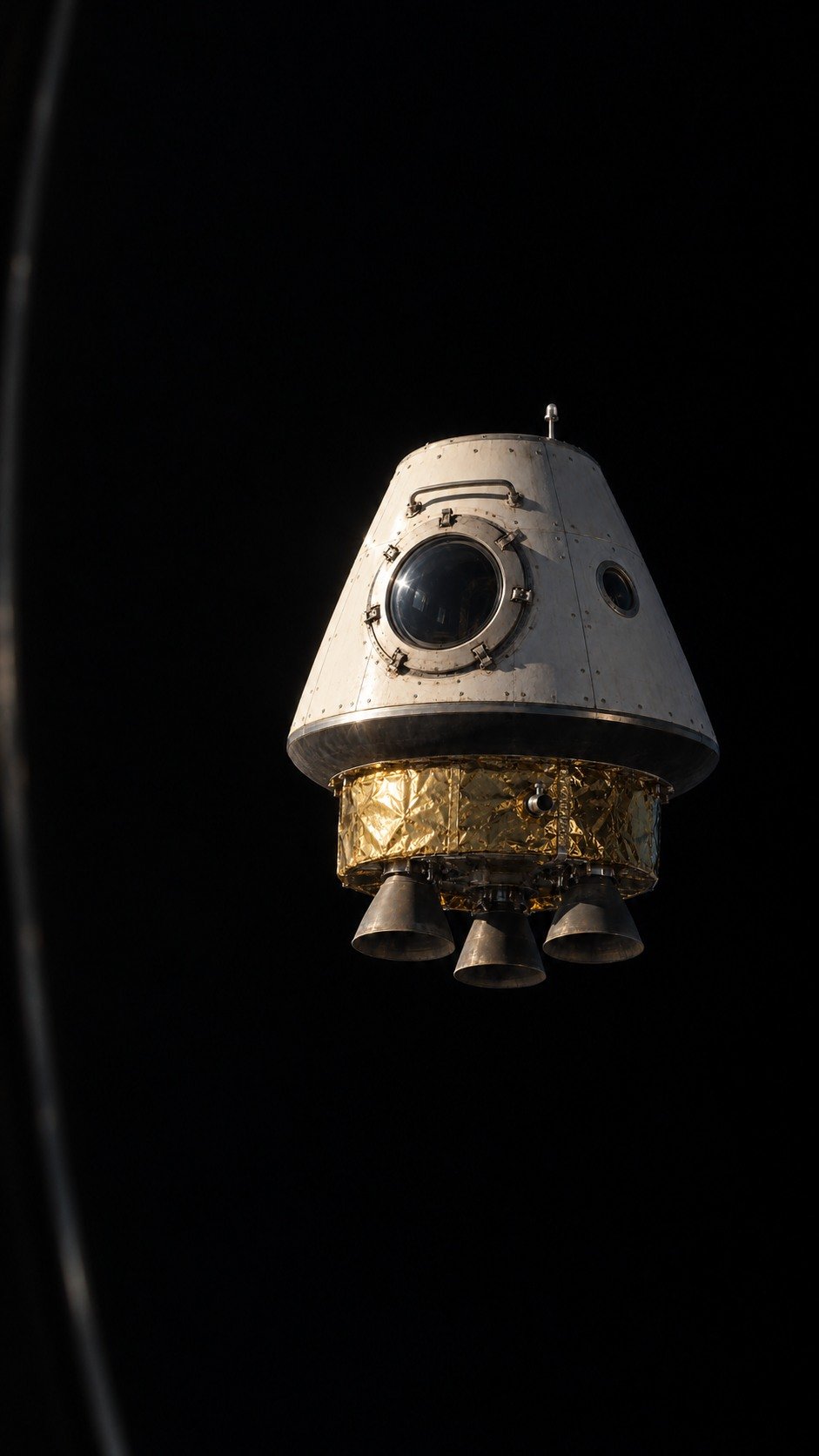
Orbit
400 × 400 km
Engine 0 N
Reference vehicle mast lamp. Photograph stays unchanged.
Light circuit
MODEL · Ideal circuit
Example circuit. Drag the handle right.
Mast beacon on. Cabin light off. Radio on.
MODEL · 24 V
Total 0.75 A / 18 W
Drag the handle left or right.
“No one is coming. So I'm starting.”
Model boundaries
The two light branches never connect simultaneously. The radio stays on its independent branch. This diagram does not verify real capsule wiring; the photograph does not change with the switch.
MODEL: 24 V; beacon 48 Ω; cabin 24 Ω; radio 96 Ω. I = V/R; P = VI. Example battery capacity 20 Ah; no real endurance claim.
The selector powers one of two light branches. The radio has a separate branch. Space or Enter toggles. Right and End select cabin; Left and Home select beacon. Escape cancels.
This scene needs JavaScript. The book remains readable.
This sentence isn't romantic, but it's true.
And truth is the only thing that keeps a person standing.
Final Reminder
No one is going to save you, but that doesn't mean you're alone.
It means you no longer have an excuse to hide.
And that's exactly where life begins.
What Does Saving Yourself Not Include?
If you've read this far, your mind might drift to this:
“Okay. Then I'm resetting everything.”
“I'm closing the door on the past.”
“I'm throwing the pain in the trash.”
“I don't need anyone.”
Stop.
Saving yourself is not about hardening.
It is not about ignoring anything.
This book did not try to turn you into stone.
It tried to clarify things for you.
So let's first distinguish this:
What self-rescue is not.
It Is Not Erasing the Past
Self-rescue is not erasing the past.
What happened happened. There is no memory button.
And even if there were, it wouldn't empower you.
People who try to erase the past go two ways:
Either denial or repetition.
Because what is not seen cannot be resolved.
But you must distinguish this:
Remembering the past is one thing; being ruled by the past is another.
The Adlerian perspective is clear here:
The past provides explanation.
But it does not dictate direction.
Saving yourself means removing the past as your “reason” and turning it into your “knowledge.”
Knowledge is portable.
Reason drags you down.
Not Eliminating Pain
This book did not promise you this:
“You will no longer suffer.”
Because that is a lie.
Pain is not a defect in life.
It is part of life.
And it is not something that needs to be eliminated.
Saving yourself is not about silencing pain.
It is about learning to live with pain.
The person who tries to eliminate pain:
- Suppresses it.
- Escapes it.
- Numb it.
- Keeps busy.
And after a while says:
“Everything is fine, but I feel empty inside.”
Because the pain hasn't gone away.
It has only shifted.
In the Adlerian view, maturity is this:
Not losing your direction even when there is pain.
Pain does not have to stop you.
But it can slow you down.
And that is normal.
It's Not about Cutting Yourself off from Everyone
Saving yourself is not saying, “I don't need anyone.”
This sentence sounds powerful.
But most of the time, it's a defense.
Because people either escape like this:
- By becoming overly attached
- Or by completely cutting themselves off
Both are extremes, and neither builds relationships.
In the Adlerian view, mental health is strengthened by a sense of community.
Self-rescue is this:
Not leaning on everyone.
But also not excluding anyone.
This balance:
- Keeping responsibility within oneself
- But not trying to carry life alone
Not dependency. But certainly not isolation.
Clear Distinctions
Saving yourself:
- Is not erasing the past.
It is removing the past from the driver's seat.
- Is not eliminating pain.
It is being able to move forward despite the pain.
- Is not disconnecting from everyone.
It is establishing relationships without transferring responsibility to others.
These differences are critical.
Because if you start from the wrong place, you disconnect from life while saying, “I am saving myself.”
Quick Reminder
Saving yourself is not ignoring yourself.
Saving yourself is taking yourself seriously.
And taking yourself seriously is taking responsibility without disconnecting from life.
This is harsh but true.
And the truth keeps a person standing.
What Does Saving Yourself Entail?
Now is the time for clarity.
We've sorted out what it isn't.
Now let's talk about what it is.
Self-rescue is not an abstract enlightenment.
It is not a “feeling.” It is not a wave of motivation that comes one day.
Self-rescue is changing how you live.
And it starts with these three things.
1 - Not Making Excuses
Not making excuses does not mean saying, “I'm not struggling.”
Not making excuses means:
Not using struggle as an excuse.
Most people get stuck here:
- “I'm right.”
- “It's normal.”
- “Despite this...”
All of these statements are true.
But they all do the same thing: they suspend responsibility.
From an Adlerian perspective, the question is:
“Does this explanation motivate me or stop me?”
If it stops you, then that explanation is now an excuse.
No matter how logical it may be.
The person who saves themselves does this:
They leave the explanation where it is, but they don't let it take the wheel.
Not making excuses is not being cruel to yourself. It is being honest with yourself.
2 - Separation of Duties
This is perhaps the most critical part of this book.
Because most people get scattered when they carry things that are not their responsibility.
The separation of duties is this:
- Things under my control
- Things not under my control
It seems simple. But this is the difference that saves lives.
Saving yourself involves:
- Not carrying someone else's feelings
- Not taking on someone else's change
- Not taking on someone else's responsibility
But at the same time, it also involves:
- Accepting the consequences of your own decisions
- Taking ownership of your own procrastination
- Letting go of the phrase “They pushed me into this”
In the Adlerian view, maturity is not about taking on everything but knowing what not to take on.
People without a sense of responsibility:
- Either become victims
- Or saviors
- Or culprits
All three lock up life.
3 - Equality and Contribution
Saving yourself is not about being superior.
It is not about being special.
Saving oneself is participating in life as an equal human being.
What does equality mean?
- No one is superior to you.
- But you are not superior to anyone either.
This place is very uncomfortable.
Because there is no stage.
There is no applause.
But it is real.
And equality alone is not enough. Equality and contribution are needed.
The contribution is this:
- Not just consuming life
- Finding a way to say, “I am here.”
- Taking on a burden, however small
According to Adler, people don't contribute because they feel good about themselves.
They feel present about themselves because they contribute.
Feeling present about yourself is more solid than happiness.
The Three Together
These three don't work separately.
They are meaningful together.
- If you don't make excuses but don't differentiate between tasks, you will burn out.
- If you differentiate between tasks but don't contribute, you will disconnect.
- If you contribute but miss the balance, you will become arrogant.
Saving yourself means reestablishing this triple balance every day.
Saving yourself is choosing to participate in life without blaming anyone, without trying to save anyone, and without diminishing anyone.
This is not dramatic.
It is not about sharing.
But it is sustainable.
And what is sustainable ultimately lifts a person up.
Because no one will save you.
And yes, this is still good news.
The Ultimate Life Lie: “One Day I'll Start”
From the beginning of this book, you've seen the same lie in different guises:
“One day...”
One day when I'm more comfortable.
One day when things are clearer.
One day when I feel more ready.
One day when conditions improve.
Now, let's say this one last time in its most raw form:
“One day I'll start” is the biggest lie in life.
Because this sentence is not hope, it is procrastination.
And the most dangerous thing is that people don't say this with bad intentions. People say this thinking it is “smart.”
But there is no such thing as “one day.”
It's not written on the calendar.
It doesn't work in life.
There are only two times in life: now and never.
Own Today
Owning today is not a grand manifesto.
Owning today does not mean “Everything will change now.”
Owning today means this:
Taking today out of the category of “unimportant interlude.”
Because the language of a postponed life says:
“Today doesn't count.”
What happens if today doesn't count?
- Mistakes lose their significance.
- Words remain unfinished.
- Responsibilities are postponed.
- Life becomes a rehearsal.
And the common outcome of a life lived like a rehearsal is this:
“My life never began.”
No, it did. You just didn't sign it.
Owning today means letting go of this sentence:
“When the conditions are right...”
The conditions are never completely right.
They become right as you take steps.
The biggest trick of procrastination is this:
It makes you feel like you're moving.
You make plans.
You think.
You analyze.
You research.
You prepare.
But you don't take action, and as long as you don't take action, preparation is not progress.
Taking action doesn't mean being perfect.
Taking action doesn't mean “I'm not afraid anymore.”
Taking action means being able to move forward even when you're afraid.
In the Adlerian perspective, courage begins right here:
You can't build a life without taking risks.
And the risks we're talking about aren't usually huge things.
Most of the time it's small but realistic:
- Having that conversation
- Starting that project
- Saying “no”
- Taking on that responsibility
- Cutting out that excuse
The size of the step doesn't matter.
What matters is that the step is real.
Because a real step doesn't create a story.
It creates a result, and results change people.
Final Clarity
When you say, “I'll start one day,” what you're really saying is:
“I choose not to live today.”
This sentence is harsh but honest.
And honesty is the main language of this book.
Owning today is the most concrete way to save yourself.
Because no one else will save you.
Then the only question is:
What will you do today?
Not tomorrow.
Not someday.
Today.
Choosing a New Lifestyle
Life is not a decision.
Life is a collection of habits.
People often describe their lives from the wrong place.
“One day I made this decision...”
“At that moment, everything changed...”
These stories sound nice, but they don't tell the truth.
The truth is this:
Life is built not on big decisions, but on small choices.
And those small choices, unnoticed, become a lifestyle.
Why Are Small Choices So Determinative?
Because small choices don't get challenged.
No one judges you.
No one applauds you.
No one stops you.
- You didn't speak up today.
- You procrastinated today.
- You passed the buck today.
- You said, “I'll manage for now.”
These things aren't dramatic on their own. But they repeat.
And everything that repeats begins to write who you are.
This is where Adler's uncomfortable clarity comes in:
People live by their habits, not their destiny.
No one breaks down in a day.
No one becomes strong in a day.
But everyone moves a little more in the same direction every day.
What Does Lifestyle Mean?
Lifestyle is not luxury; it is not aesthetics.
Lifestyle is this:
What you do when you are challenged.
What you don't give up when you don't feel like it.
How you behave when no one is watching.
Lifestyle is not what you think, but what you remain faithful to.
And loyalty is not measured by feelings, but by actions.
The Power of Consistency (Why Is It Underestimated?)
Consistency seems boring.
Because consistency doesn't produce stories.
It doesn't create shareable moments.
It doesn't make people say “wow” from the outside.
But stability does this:
It makes life manageable.
A stable person:
- Doesn't have to be motivated every day.
- Doesn't have to convince themselves every day.
- Doesn't have to start over every day.
Because the direction is clear, and if the direction is clear, emotions can fluctuate.
From an Adlerian perspective, mental health is strengthened not by high emotions, but by predictability.
When a person knows a little about what will happen, their mind calms down. Life expands.
Why Is Stability So Difficult?
Because stability is unapplauded, and maintaining something that receives no applause is difficult for the ego.
Many people want the following:
- Quick results
- Visible progress
- A meaningful feeling
But stability doesn't guarantee these things; it only guarantees not falling apart, and not falling apart is the least romanticized but most vital skill in life.
Lifestyle Isn't Chosen in a Day
No one wakes up in the morning and says, “From today on, I have a stable life.”
Lifestyle is chosen here:
When you don't run away today.
When you don't procrastinate today.
When you don't abandon responsibility today.
These seem small, but they accumulate.
And what accumulates is this:
Self-confidence.
Self-confidence doesn't come from feeling good.
Self-confidence comes from not abandoning yourself halfway.
Lifestyle is not a vision.
It is never an intention.
Lifestyle is small but honest choices repeated in the same direction.
Stability is not flashy, but it is redeeming.
Because if there is stability, life cannot knock you down.
And a person who is not knocked down will get up sooner or later.
This book did not give you a new identity.
It did not write a new story for you.
It did not try to motivate you.
It did only one thing:
It silenced the excuses.
Because in the end, all roads lead to the same question.
No matter what the past holds.
No matter how difficult the circumstances.
No matter what your feelings say.
What are you doing right now?
This question is not philosophical.
It is not emotional.
It does not try to appear profound.
This question is a question of direction.
Life is not complicated. The mind complicates it.
That's why your compass can't be big. It has to be simple.
Every day, every moment, in every situation, it's enough to look in one place:
- Are you running away, or are you staying?
- Are you procrastinating, or are you doing it?
- Are you making excuses, or are you taking responsibility?
Whatever the answer is, that's where your life is.
Feelings can change, motivation can drop, and circumstances can deteriorate.
But this question remains unchanged.
What are you doing right now?
The moment you ask this question:
- Victimhood ends.
- Expectations of a savior diminish.
- The past falls silent.
- The future shrinks.
Only the present remains.
And the present is the only real space of life.
Final Sentence
The only sentence this book wants to leave you with is this:
Life is not something that will start one day.
Life is what you are doing right now.
And what comes next is now up to you.
You Don't Have to Be Happy
Throughout this book, I haven't sold you happiness.
Because happiness is not a promise.
It is never a duty.
You don't have to be happy.
You don't have to feel good.
You don't have to feel ready, motivated, or confident.
But you have to live.
That means you can't run away, procrastinate, or make excuses.
The modern world whispered to you:
“Feel good first, then take action.”
But that was a lie.
The truth is this:
You take action, you take responsibility, and you contribute.
Sometimes you feel good, sometimes you don't.
But life doesn't stop.
If happiness comes, great; if it doesn't, the path isn't ruined.
Because the measure of the path is not feeling, it's direction.
And the direction is hidden here:
Now, here, in what you undertake.
The final clarity this book leaves you with is this:
You don't have to be happy.
But you also don't have the right to postpone your life.